
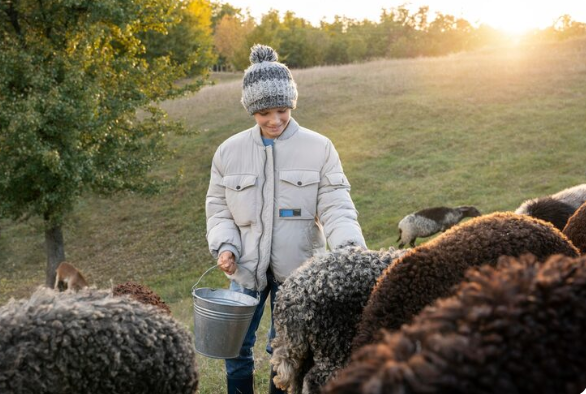
Following the Good Shepherd: Understanding Our Role and His
“I am the good shepherd; I know my sheep and my sheep know me—just as the Father knows me and I know the Father—and I lay down my life for the sheep.”
John 10:14–15 (NIV)
Few images in Scripture are as tender, personal, and revealing as Jesus calling Himself the Good Shepherd. With these words, Jesus draws from centuries of biblical imagery and lived experience to describe both who He is and who we are in relationship to Him.
Long before Jesus walked the earth, King David wrote with deep conviction, “The LORD is my shepherd; I shall not want.” David knew something about shepherding firsthand. He had lived among sheep, protected them, guided them, and fought for them. Yet what David knew in part, we now know in full: Jesus is the Good Shepherd.
This truth is not merely poetic or symbolic. It defines the nature of our relationship with Christ, clarifies His role in our lives, and humbly reminds us of our own.
The Shepherd’s Role: Caretaker, Protector, and Provider
To understand Jesus as the Good Shepherd, we must understand what a shepherd actually did. Shepherding in biblical times was not romantic or idyllic. It was a demanding, uncomfortable, and often dangerous vocation.
A shepherd lived with the sheep—day and night. There were no breaks, no time off, no escape from the responsibility. Shepherds guided their flocks to food and water, watched for signs of illness or injury, and ensured the sheep could rest safely. They led them through valleys and over rugged terrain. They stayed alert while others slept.
The job was also dangerous. Wild animals such as lions and bears posed real threats. When predators attacked, the shepherd stood between the danger and the sheep—sometimes at the cost of his own life. A shepherd did not abandon the flock when trouble came. He stayed.
Jesus intentionally chooses this image to describe Himself.
He is the One who watches over us.
He is the One who protects us from danger—seen and unseen.
He is the One who feeds our souls and leads us to rest.
And unlike any other shepherd, He lays down His life for the sheep.
The Good Shepherd’s love is not theoretical. It is sacrificial.
A Shepherd Who Knows His Sheep
Jesus says, “I know my sheep and my sheep know me.” This knowing is deeply relational. It speaks of intimacy, trust, and familiarity.
In the ancient world, shepherds often named their sheep. They knew their tendencies, their weaknesses, and their habits. They recognized individual sheep by sight and sound. In return, sheep learned to recognize the shepherd’s voice and would follow only him.
This is the kind of relationship Jesus invites us into.
He knows us fully—not just our strengths, but our fears, failures, and wandering tendencies. And yet, He still calls us His own. He still leads. He still protects. He still loves.
The Sheep’s Role: Dependent, Vulnerable, and Needy
If Jesus’ role is the Good Shepherd, then ours is unmistakably clear: we are the sheep.
This is not a flattering comparison.
Sheep are often described as smelly, needy, defenseless, and unwise. They lack strong instincts for survival. Left on their own, sheep will wander aimlessly with no sense of direction. They can easily fall into pits, stray far from food and water, or expose themselves to danger without realizing it.
And yet, Jesus chooses this analogy intentionally—because it fits.
Like sheep, we are prone to wander.
Like sheep, we lose our sense of direction.
Like sheep, we focus on what is directly in front of us and miss looming dangers.
Like sheep, we often fail to recognize consequences until it is too late.
This wandering happens not just physically, but spiritually—within our souls.
Our lives are busy, crowded, and noisy. We fill our days with responsibilities, ambitions, and distractions—some important, many not. Over time, we lose awareness of where we are spiritually. We drift. We become vulnerable. And often, we do not realize how far we have wandered until we are exhausted, wounded, or afraid.
The Simplicity—and Difficulty—of Our Role
Jesus’ role is the Shepherd. Our role is the sheep.
In essence, that role is simple: listen and follow.
Yet in practice, it is anything but easy.
Jesus says, “My sheep know my voice.” To be a “good” sheep is to recognize the Shepherd’s voice and respond to it. It means trusting His guidance—even when it does not make immediate sense.
Psalm 23 paints a beautiful picture of this dynamic. The Shepherd leads the sheep to rest, to nourishment, and through valleys. Sometimes He makes us lie down. Sometimes He leads us forward. Sometimes He walks with us through darkness.
Our responsibility is not to understand every step—but to obey.
Some of Jesus’ guidance feels natural.
Some feels difficult but manageable.
And some feels nearly impossible.
Still, the call remains the same: follow His voice, no matter what.
Learning to Hear the Shepherd’s Voice
One of the most common struggles among believers is the sense that God is silent. We wonder why His voice feels distant or unclear. Yet Jesus assures us that He is speaking.
Wherever you are right now, He has a word for you.
A word of peace.
A word of guidance.
A word of love.
A word of hope.
If we struggle to hear Him consistently, the issue is not with the Shepherd. It is often with the sheep.
Noise dulls our spiritual hearing. Distraction weakens our attentiveness. Hurry crowds out discernment. Over time, the voice of the Shepherd becomes harder to distinguish from the many competing voices around us.
Hearing Jesus requires intentional stillness.
Creating Space to Listen
The sheep cannot hear the shepherd if the field is filled with noise.
This is why learning to follow the Good Shepherd requires creating space—space for silence, prayer, and attentiveness. Not every moment of prayer needs to be filled with words. Sometimes the most faithful posture is listening.
Take time—real, intentional time—to quiet your surroundings.
Turn off the television.
Silence background music.
Put your phone away.
Even five minutes of undistracted stillness can recalibrate the soul.
Begin with a simple prayer, inviting Jesus to speak. Then resist the urge to fill the silence. Make room for the Shepherd to lead the conversation.
It would be rather odd if the sheep spent all their time telling the shepherd what they needed—and never listened for direction.
The Discipline of Stillness
You may not hear anything immediately. And that is okay.
Learning to recognize the Shepherd’s voice is a process. Sheep become familiar with their shepherd’s voice over time—through proximity, repetition, and trust.
The same is true for us.
The more we practice stillness, the more attuned we become.
The more we listen, the clearer His voice grows.
The more we obey, the deeper our trust becomes.
Do not be discouraged by silence. Often, God is doing a deeper work beneath the surface—shaping attentiveness, humility, and dependence.
Trusting the Shepherd’s Character
At the heart of following Jesus is trust.
We can follow His voice because we trust His heart.
We can obey His leading because we know His character.
We can surrender control because He has already laid down His life for us.
The Good Shepherd does not exploit His sheep.
He does not abandon them.
He does not lead them into danger for His own gain.
He leads out of love.
When we doubt His guidance, we need only look to the cross. The Shepherd who laid down His life has already proven His devotion to our good.
Resting Under the Shepherd’s Care
One of the most beautiful aspects of the shepherd metaphor is rest.
Sheep do not rest unless they feel safe.
They will not lie down if they sense danger nearby.
Rest comes only under the watchful presence of the shepherd.
Many believers struggle with rest—not because they lack time, but because they lack trust. We strive, worry, and attempt to control outcomes that were never ours to manage.
The Good Shepherd invites us to rest.
To lie down.
To trust His vigilance.
He watches while we sleep.
He guards while we are unaware.
He carries burdens we were never meant to bear alone.
Becoming Faithful Followers
Our role as sheep is not to lead.
Not to manage.
Not to figure everything out.
Our role is to follow.
That means responding when the Shepherd calls.
Moving when He leads.
Stopping when He says rest.
Trusting when the path feels uncertain.
Faithful following is not passive—it is attentive, responsive, and obedient.
And while we may stumble, wander, or resist at times, the Shepherd does not give up on His sheep. He pursues. He restores. He brings us back.
A Daily Invitation
Jesus is still the Good Shepherd.
We are still the sheep.
And the invitation remains the same.
Listen.
Follow.
Trust.
Take time today to ask yourself:
Where have I been wandering?
What voices have I been following?
When was the last time I truly listened for the Shepherd’s voice?
Then create space.
Be still.
And let the Good Shepherd lead.
With practice, patience, and trust, we can learn to follow Him better every day—and find ourselves safe, nourished, and deeply known under His loving care.